
Each and every millisecond matters in the world of online gaming. Gamers love to stream live gameplay on Twitch, enjoy a smooth multiplayer session with friends, even love to get locked in an intense battle, but the last thing they want is lag. Many gamers focus on high-end graphics cards, processors and monitors, that is fine but what about your router?. Actually the router is a doorway between the gaming rig and the world. It plays an important role in the gaming world.
This is where the gaming routers really come in. It's not like standard routers that only distribute internet connections across devices. Gaming routers are specially designed to reduce delay, prioritize gaming traffic even at the time of streaming netflix in 4K your ping doesn’t go high.
In this post, we’ll discuss about the top gaming router brands available in 2025. We have highlighted the unique features, pros and cons and flagship products. Based on this you can figure out which one suits you well for your needs.
Why you need a Gaming Router
In gaming two metrics are important more than internet speed - ping and packet stability.
Ping is the time taking for data to travel from your device to the game server and back. A normal router may deliver the packets at the stable speed of 60 mbps connection. But if its latency spikes under the load then your character may lag in critical situation.
Packet Stability make sure that there is no data lost or delayed on the way. Gaming routers minimize packet loss using advanced feature Quality of Service (QoS).
Key Features of Gaming Routers
Quality of Service (QoS)
It is an important feature in modern gaming routers. Simply we can say it is a smart traffic management system. This feature enables us to configure the router to prioritize gaming traffic from gaming apps in favor of all other traffic from other apps like Netflix or YouTube. It treats our gaming packets like VIPs on the network.
In most of the homes multiple devices are sharing the same internet, this may cause increase in ping or packet loss during online gaming particularly when other devices start streaming videos or downloading large files.
Many routers have “Dynamic Qos” or “Adaptive Qos” that automatically detects gaming traffic, no manual setup needed.
Dedicated Gaming Ports
This is one of the standout features in many high-end gaming routers. A special LAN port designed to give top priority to the gaming device on the network.
A dedicated gaming port solves this problem using hardware-level Quality of Service (QoS). When we connect our gaming or PC to this port, the router automatically detects and mark it as a high-priority device and allocate more bandwidth and reduce latency.
OFDMA and MU-MIMO
One of the biggest performance challenges is how well the routers can handle multiple devices connected on the same network. The router responds to all the devices which demand data simultaneously.
This is where OFDMA (Orthogonal Frequency Division Multiple Access) and MU-MIMO (Multi-User, Multiple Input Multiple Output) come in. Two powerful technologies introduced in Wi-Fi 6 and improved further in Wi-Fi 6E and 7. This feature ensures that our online games stay smooth, responsive and lag-free, even if other devices are online.
MU-MIMO - It allows the router to communicate with multiple devices at the same time i.e sending multiple data streams simultaneously.
OFDMA - It is the next evolution. Instead of sending one full data packet to one device at a time it divides the data into small Resource Units (RUs). Each RU carries data packets for different devices at once.
Wi-Fi Standards: Wi-Fi 6, 6E, and 7
The Wi-Fi standards that our device supports plays a huge role in overall performance. Wi-Fi technology evolution is massive over the years to meet the speed, stability and ability to handle more connected devices.
Wi-Fi 6 (802.11ax) - Introduced in 2019, Wi-Fi 6 became a major breakthrough from Wi-Fi 5. It’s built to handle multiple devices like consoles, PCs, smartphones, smart TVs etc., connect simultaneously.
- Upto 9.6Gbps total speed
- Has OFDMA and MU-MIMO technology
- Better Battery efficiency
Wi-Fi 6E - Letter “E” stands for Extended. It is an extended version of Wi-Fi 6. It can also operate on 6 GHz frequency. It supports 14 additional 80MHz channels or 7 super wide 160MHz channels.
- Free from interference and congestion
- Ultra low latency
- Uninterrupted data flow due to its channels.
Wi-Fi 7 (802.11be) - This is the latest evolution so it's just appearing in top end routers like ASUS ROG Rapture GT-BE98 Pro and Netgear Nighthawk RS700S. It is designed to drive wireless technology to the limit of wired ethernet.
- Upto 46Gbps speed (5 times faster than Wi-Fi 6)
- Combines multiple frequency band (2.4GHz, 5GHz and 6GHz)
- Perfect for high frame rate gaming, 8K streaming and VR
Top Gaming Router Brands
1. ASUS (Republic of Gamers)
In gaming hardware, ASUS is one of the most trusted brands especially for their Republic of Gamers (ROG) routers. They make routers with powerful internals, and design with gamers in mind, complete with RGB lighting, gaming-optimized firmware and dedicated ports.
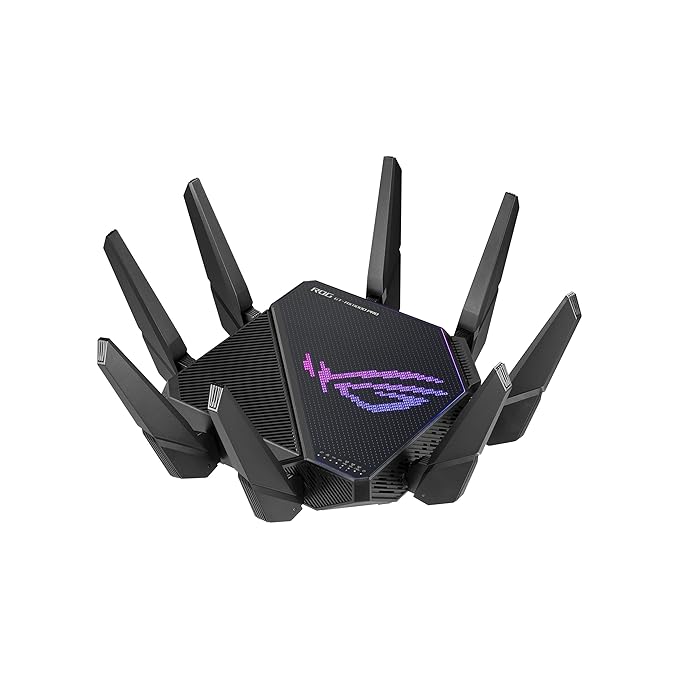
Flagship Model: ASUS ROG RAPTURE GT-AX11000 Pro
- Wi-Fi Standard: Wi-Fi 6 (802.11ax), Tri-band
- Speed: Upto 11,000 Mbps combined
- Ports: 2.5G WAN port, 4- LAN and 1-dedicated gaming port
- Features: AiMesh support, Game Boost, Adaptive QoS, RGB lighting
Pros:
- On fire fast speeds suitable for Gigabit internet
- Tri-band setup provides one dedicated band for gaming
- Strong security
- Perfect for big homes with multiple gamers
Cons:
- Expensive at $450
- Excess for casual gamers with slower internet
2. Netgear (Nighthawk & Pro Gaming Series)
Netgear is a familiar name in networking, and their Nighthawk Pro Gaming routers are popular among the competitive gamers. They are recognised for their DumaOS firmware. These routers provide advanced customisation and features like Geo-Filtering to confirm you only connect to servers more close to you.

Flagship Model: Netgear Nighthawk XR1000
- Wi-Fi Standard: Wi-Fi 6 (802.11ax)
- Speed: Upto 5.4 Gbps
- Ports: Gigabit LAN ports, USB 3.0
- Features: DumaOS 3.0, Geo-filtering, advances QoS
Pros:
- Amazing control for competitive gamers
- Custom QoS settings for bandwidth allocation
- Good coverage for medium to large homes
Cons:
- Expensive at $300 - $350
- Embedded software updates are sometimes delayed
3. TP-Link (Archer & GX Series)
TP-Link always provides value for money gaming routers with high-end features at a lower price than ASUS or Netgear.

Flagship Model: TP-Link Archer GX90
- Wi-Fi Standard: Wi-Fi 6, Tri-band
- Speed: Upto 6.6 Gbps
- Ports: 2.5G WAN/LAN, Gigabit LAN ports, USB 3.0
- Features: Game Accelerator, OFDMA, MU-MIMO
Pros:
- Nominal for its features at $250
- Dedicated gaming band
- Strong security and parental controls
Cons:
- Less advanced app than ASUS/Netgear
- Bulky design
4. MSI (Radix Series)
MSI has recently entered the router market. They are well known for motherboards and GPUs.
Their Radix series is a combination of style and performance with futuristic designs and RGB lighting to match gaming setups.
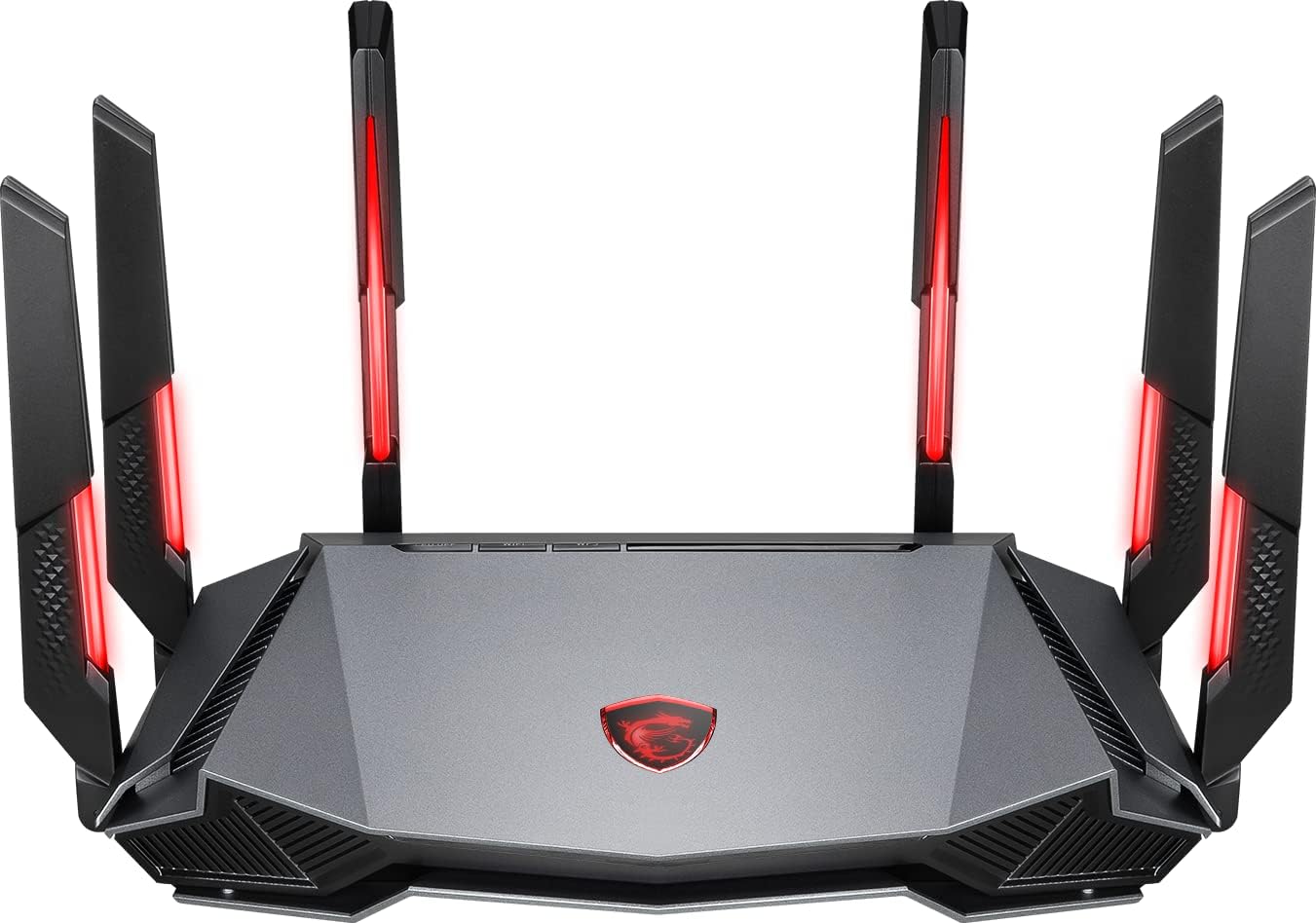
Flagship Model: MSI Radix AXE6600
- Wi-Fi Standard: Wi-Fi 6E
- Speed: Upto 6.6 Gbps
- Ports: 2.5G WAN, Gigabit LAN ports
- Features: MSI QoS, triband, RGB lighting
Pros:
- Wi-Fi 6E support future-proofing
- Gamer centric design
- Reasonable price for its performance ($300)
Cons:
- Fewer models available
- Less ecosystem support than ASUS or Netgear
5. Linksys (High-end Hydra Series)
Linksys has been a networking field for decades. Usually not always marketed at gamers, but their high-end models like Hydra Pro series offer extraordinary speed and reliability.
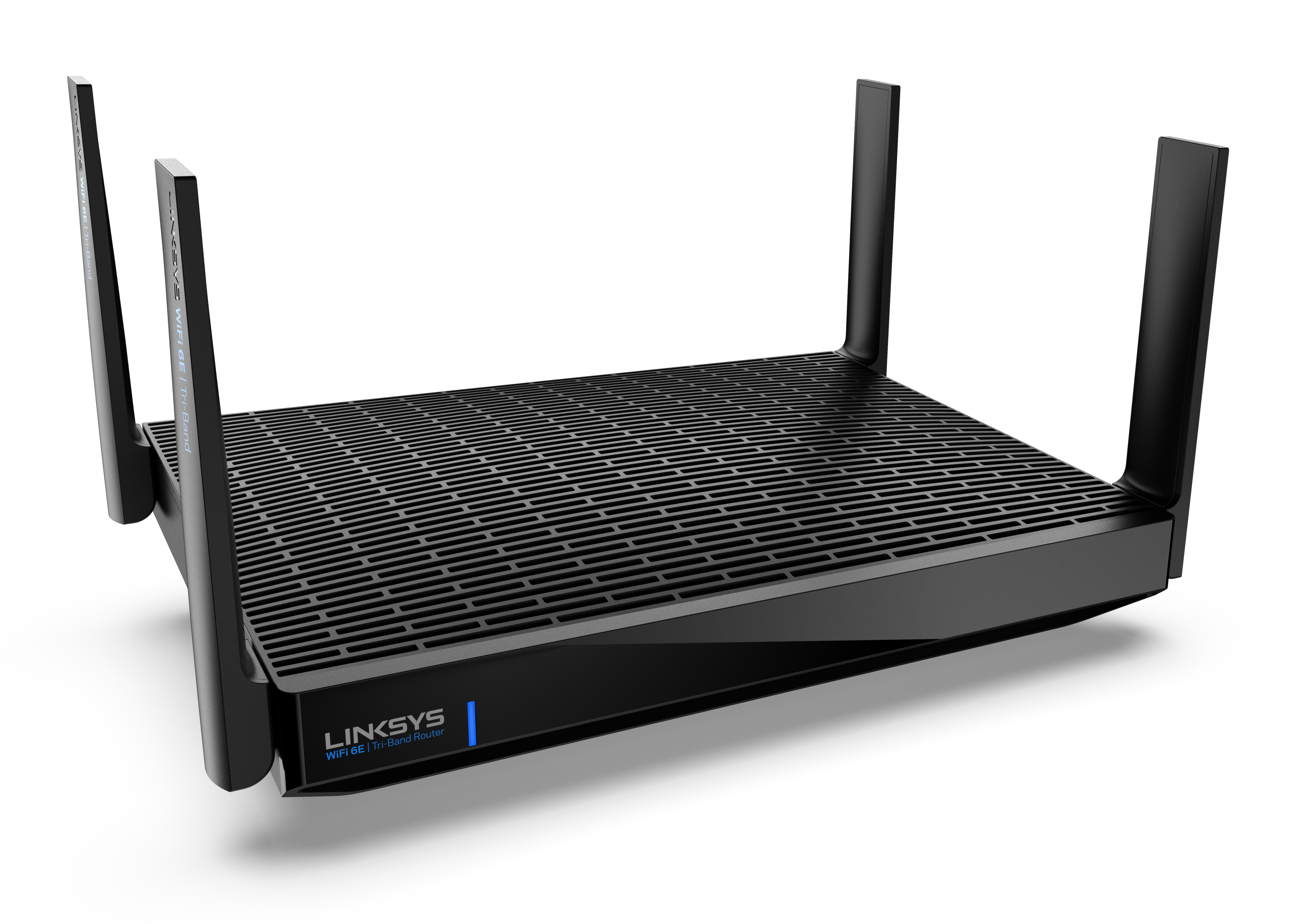
Flagship Model: Linksys Hydra Pro 6E
- Wi-Fi Standard: Wi-Fi 6E
- Speed: AXE6600
- Ports: 5 Gigabit Ethernet ports
- Features: Mesh support, intelligent Mesh tech, WPA3 security
Pros:
- Reliable performance and coverage
- Suitable for large homes
- Wi-Fi 6E support future-proofing
Cons:
- Specifically not a gaming brand
- Less flashy than ROG or Nighthawk
6. Ubiquiti (Amplifi & Unifi Series)
Ubiquiti is a favourite brand among professionals and enthusiasts who need enterprise-grade networking at home. Not branded as gaming routers, still the routers like Amplifi Alien deliver stability, mesh capabilities and advanced customisation.

Flagship Model: Linksys Hydra Pro 6E
- Wi-Fi Standard: Wi-Fi 6
- Speed: Upto 7,685 Mbps
- Ports: Gigabit LAN, WAN
- Features: Mesh support, Touchscreen display, OFDMA
Pros:
- Extremely stable for heavy gaming
- Idea for large homes
- Enterprise-level reliability
Cons:
- High Price ($379)
- Requires some technical knowledge to get the most of it